
the details.
Lyme disease is a complex vector-borne illness, and many people are unaware of the its stealth nature.
Vectors are living organisms that transmit pathogens. Common vectors are mosquitos, ticks, and fleas. A Lyme infection can be joined by co-infections, which are other infections that ticks can carry and transmit. These infections can be bacterial, parasitic, and viral. Lyme disease has 3 stages: early localized, disseminated, and late stage. Late stage Lyme disease is dangerous and often leaves people disabled. And sometimes worse… yeah, not good!

But stress not, continue reading!
lyme disease explained.
Lyme disease (AKA Borrelia Burgdorferi)
The cause of Lyme disease is a spirochete bacterium called Borrelia burgorferi which was properly discovered in 1982 by scientist Willy Burgdorfer when studying rocky mountain spotted fever in 1981 (it is named after him because he discovered it… just in case that wasn’t clear). It’s a cousin to Syphillis (yeah, they’re related!). The disease itself is named after Lyme, CT. We’ll explain what happened there shortly.
Borrelia burgdorferi is only one of the many species of Borrelia.

borrelia (Lyme).
syphillis.


a series of unfortunate events
how lyme happened.
Lyme disease has been around for thousands of years. Not to mention, the bacteria which causes Lyme disease was recently found in a 5,300 year old mummy, also known as Ötzi the Iceman. More than 130 years ago, German physician Alfred Buchwald was the first to describe the chronic skin rash called a ‘bullseye rash’ (erythema migrans), which is the most distinct but not so common initial sign of Lyme disease. However, the United States didn’t recognize Lyme disease until around the 1970s.
So, what happened in the 1970’s? You’re about to find out.

he had lyme, too.
Museum of Archaeology by Kennis & Kennis, 2011.
Reconstruction of Ötzi the Iceman
(c) South Tyrol Museum of Archaeology
1970s-1980s
lyme, ct. usa
a town gets sick.
Early 1970’s: a mysterious illness begins to plague the people of Lyme, CT. They exhibit symptoms of arthritis, fatigue, swollen knees, paralysis, skin rashes, and headaches. Doctors are stumped on the cause. All the people recalled being bitten by a tick in the Lyme, Connecticut region. shocking discoveries.
By 1975, researchers began describing the signs of this sickness. They called it Lyme, but they were still unsure of the cause. That is until 1981 when scientist William Burgdorfer, who at the time was studying Rocky Mountain Spotted fever (a tick-borne illness), started studying Lyme disease. He then found a connection between the deer tick and the disease. He discovered that a spirochete bacterium carried by ticks was causing the disease.and then what?
The medical community honored him by naming this spirochete after him. Borrelia burgdorferi, they called it. After that, doctors began to use several different antibiotics to treat the disease. While most treatments were largely successful in the early stages of the disease, Lyme that has progressed has appeared to be resistant to a short course of antibiotics.actual ‘newsweek’ article on lyme disease, 1989.
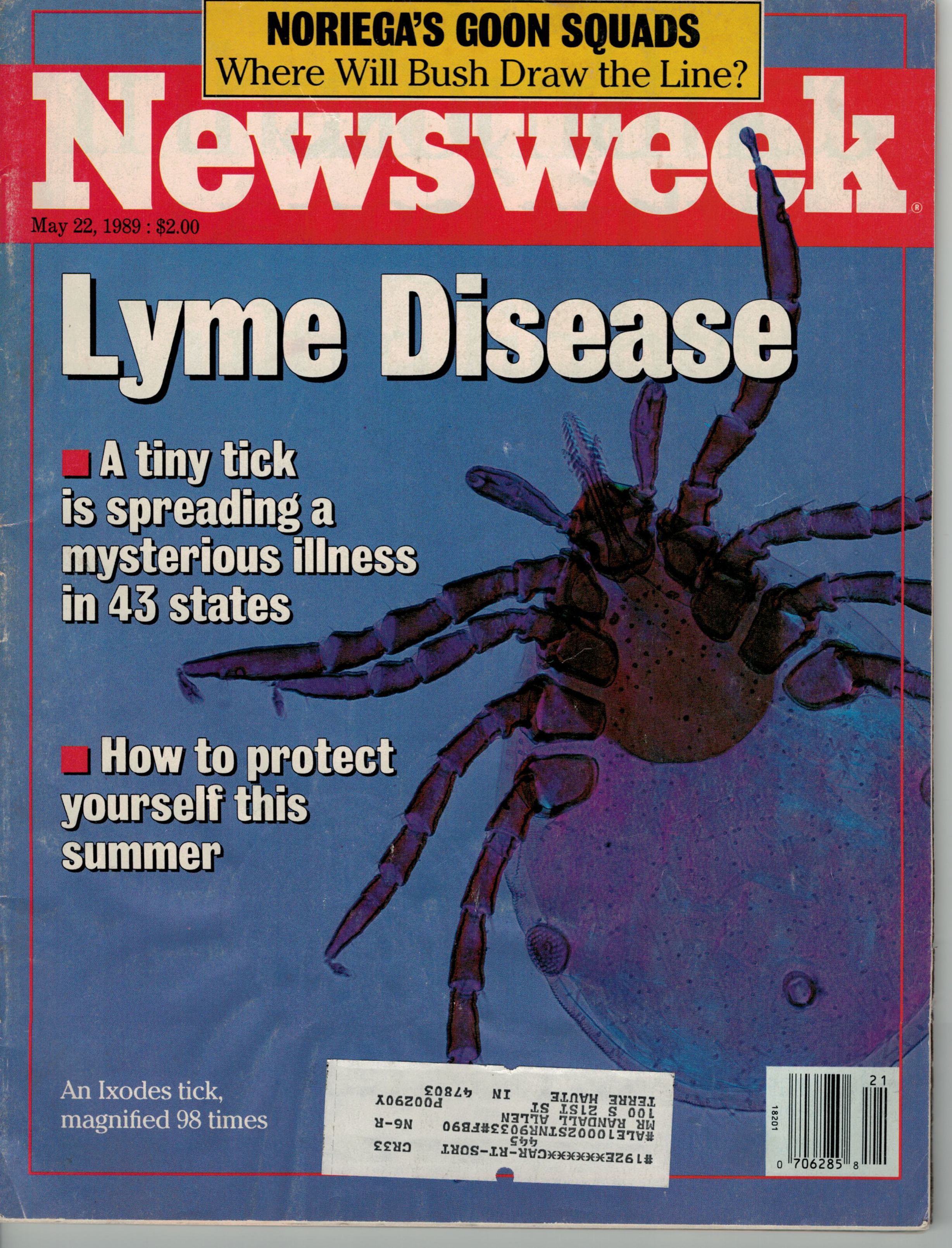
click image to read.
the real people of lyme, connecticut.



the symptoms.
* - For heart or neurological symptoms seek medical care immediately
1. EARLY LOCALIZED (days/weeks after infection)
Skin rash
Bullseye rash (only around 30% of patients)
Headaches or stiff neck
Flu-like symptoms, including fever or chills
Muscle and joint pain
Fatigue or lack of energy
A small bump or redness at tick bite
Swollen lymph nodes
2. DISSEMINATED (weeks/months after infection)
Multiple skin rashes
Heart palpitations*
Fainting/syncope*
Pain or numbness in arms and legs
Extreme joint pain
Profound fatigue
Headaches and lack of energy
Bell's palsy (facial paralysis)*
Poor memory or inability to concentrate
3. LATE STAGE (months/years after infection)
Arthritis, particularly in knee or near point of infection
Nervous system problems, including numbness and tingling in hands, legs, feet, or back
Stiff neck, severe headaches, or migraines*
Problems with memory, hearing and vision*
Chronic debilitating fatigue
Mood or sleep disorders
Inflammation of heart or brain*
The symptoms of Lyme disease can mimic many other illnesses, which is another obstacle patients face. Let’s break this down.
Because the Lyme bacteria can invade any organ or system within the body and can cause autoimmune-type reactions, it is capable of causing symptoms of various diseases, even specific to that part of the body if it is progressed.
Here are examples:
-
Lyme disease can weaken the immune system and in turn elicit and/or trigger diseases such as:
Arthritis
Lupus
Scleroderma (overproduction of collagen, can lead to tissue death)
POTS (Postural Orthostatic Tachycardia Syndrome)
-
Neuropsychiatric symptoms in Lyme disease can be caused by the infection being present within the brain and/or nervous system, or by having a weakened Blood-Brain Barrier (BBB) either prior to infection or caused first-hand by active infection. This can allow inflammatory agents, such a cytokines, and other toxins within the blood to cross into the brain. This compromise of the nervous system can cause depression, anxiety, paranoia, anger/rage, memory loss, cognitive decline, and more.
-
Chronic inflammation of the heart tissues can be caused from a Lyme infection of this organ. People can and have perished from this condition.
-
Lyme disease can infect the central nervous system and can cause a list of symptoms that mimic neurological conditions (and in some cases can even trigger these diseases) such as:
Multiple Sclerosis
Tranverse Myelitis (spinal cord inflammation)
Parkinson’s Disease (read here)
And More
There are anecdotal testimonies of Lyme treatment improving some patient’s pre-existing health conditions like the ones listed above. While pathogenic illness is not the single cause for these conditions, correlation has been found. it might be worth exploring how many people with these conditions could test positive for IgG and IgM antibodies on serum tests. (read more)
lyme spirochete cell structure.
Spirochete bacteria are complex, pathogenic organisms. Here we can breakdown the cell structure of the spirochete:
-
Composed of an inner membrane (plasma membrane) and a distinct, fragile outer membrane (OM) sheath, giving it a typical diderm profile. A diderm profile means that there are two membranes.
-
The Periplasmic space is the region between these membranes that includes a variety of enzymes and functions, including the oxidation and quality control of proteins. Also within the periplasmic space is a layer of crosslinked sugars and amino acids termed peptidoglycan, which surrounds the cell.
-
Borrelia burgdorferi, possesses a unique, highly specialized outer membrane (OM) that serves as the interface between the bacterium and its host or vector. Unlike typical Gram-negative bacteria, the B. burgdorferi outer membrane is notably devoid of lipopolysaccharide (LPS).
-
Located between its inner and outer membranes. These endoflagella, anchored at both ends of the cell, rotate to create a corkscrew-like motion for motility, allowing the bacteria to move through viscous tissues. They’re similar to propellers.
-
Its unique movement is driven by an axial filament—a bundle of periplasmic flagella (endoflagella)—that runs lengthwise in the periplasmic space, wrapping around the cell cylinder between the inner and outer membranes.
co-infections.
Co-infections of Lyme disease are additional infections a person can acquire from the bite of an infected tick. These infections can be bacterial, parasitic, and viral.
They can be hard to treat depending on how long a person has been infected, and some require antimalarial drugs (parasitic meds).
You, probably: “there can be more infections? You’ve got to be kidding me.”
Us, sadly: “Not kidding, keep reading :)”
-
Bartonella
Common cause is B. henslae. Lives and reproduces within the lining of blood vessels. Can cause systemic inflammation and immune system problems such as MCAS.
Anaplasma
Caused by the bacteria A. phagocytophilum. Affects white blood cells and can come with flu-like symptoms. If treatment is delayed this can cause severe illness.
Erlichia
Caused by the bacteria Ehrlichia chaffeensis, E. ewingii, or E. muris eauclairensis in the United States. People with will often have fever, chills, headache, muscle aches, upset stomach.
Rickettsia
Rickettsia (Spotted fever). These bacteria are spread to people through the bite of infected mites and ticks.
-
Babesia
Caused by a parasite that infects red blood cells. Babesiosis can lead to hemolytic anemia. Hemolytic anemia occurs when your red blood cells are destroyed faster than they can be replaced.
Theileria
A parasitic pathogen. Although rare, it has been documented in humans in rural areas close to livestock.
-
Powassan Virus
Found in the northeastern and upper midwestern United States, this rare virus can cause severe neurological symptoms like encephalitis and meningitis.
Colorado Tick Fever Virus
Found in the mountains of the western US and Canada. Spread by the Rocky Mountain wood tick, typically causes flu-like symptoms.
Heartland and Bourbon Viruses
Emerging viral infections found primarily in parts of the Midwestern and Southern United States, spread by lone star ticks and other species.
tick lifecycles.
Most ticks go through four life stages: egg, six-legged larva, eight-legged nymph, and adult. After hatching from the eggs, ticks must eat blood at every stage to survive.
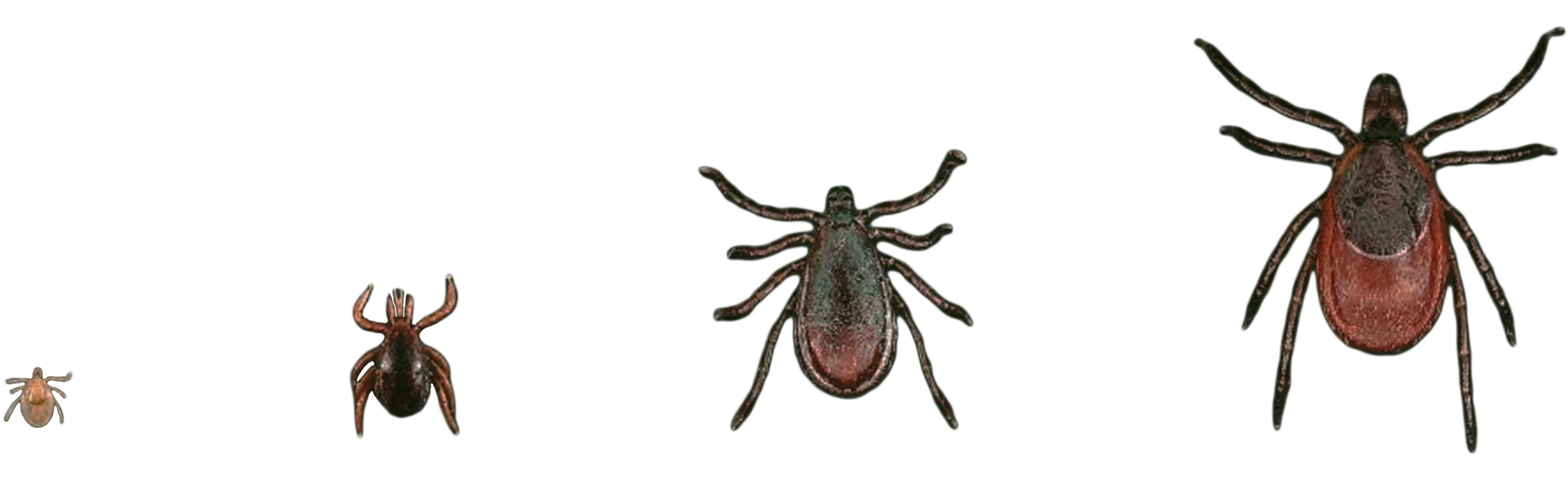
Source: cdc.gov
Above Action
knowledge check.
Only around 30% of patients report having a bullseye rash.
Doctors say the bullseye rash is common after a tick bite. It’s not. This can delay proper treatment.Lyme spirochetes can burrow into human tissues and cells.
Lyme can bury itself into human tissues and cells, evading the immune system.